
broth-like
Adjective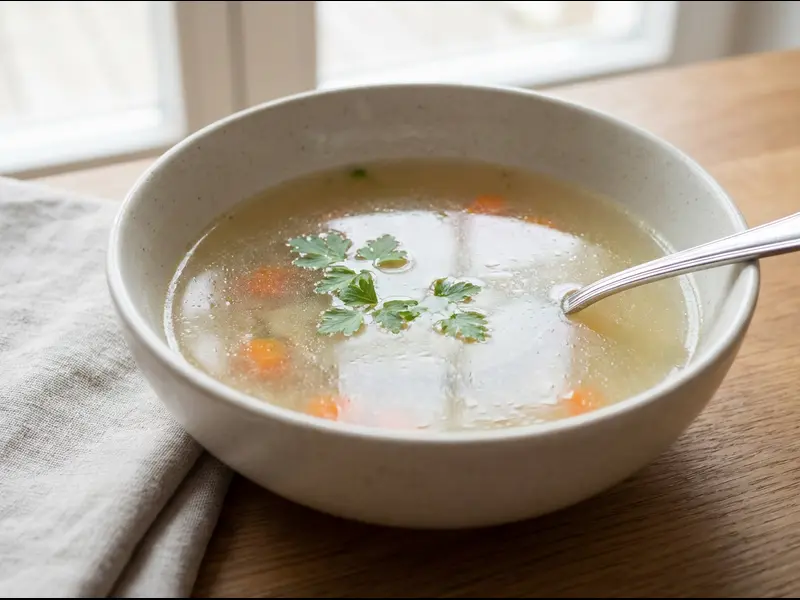
resembling a thin, watery soup
What Makes This Word Tick
Broth-like describes something that resembles a thin, watery soup—more liquid than thick, and usually light in body. It’s a sensory word that leans on texture and consistency rather than flavor. Compared with watery, broth-like suggests there’s still some savory “soup-ness,” even if it’s very thin.
If Broth-like Were a Person…
If Broth-like Were a Person…
Broth-like would be the gentle minimalist who doesn’t take up much space but still brings a little warmth. They’re light, easy to take in, and never heavy-handed. Their vibe is “soft comfort, no thickness.”
How This Word Has Changed Over Time
Broth-like is a descriptive build that stays pretty stable because it depends on a clear comparison. As people use “-like” words to describe textures, it fits easily into food writing and everyday description. The meaning remains anchored: thin and soup-resembling rather than thick or solid.
Old Sayings and Proverbs
A proverb-style idea that matches broth-like is that some things are meant to be light, not heavy. This reflects how the word points to a thin consistency rather than a dense one.
Surprising Facts
Broth-like is a quick way to convey texture without needing a long explanation, because most people can picture broth instantly. It can be used as praise (light and soothing) or critique (too thin), depending on context. The hyphenated form also signals that it’s a deliberate comparison, not a separate category of soup.
Out and About With This Word
You’ll often see broth-like in food descriptions—soups, sauces, and dishes where thickness matters. It can also show up in casual talk when someone wants to explain a texture quickly. The word fits any time you need to communicate “thin and soup-ish” in a single, clear adjective.
Pop Culture Moments Where Broth-like Was Used
In pop culture, the concept of “broth-like” texture shows up in cooking scenes where the success of a dish hinges on consistency—too thin, too thick, or just right. Those moments work because texture is instantly relatable. That matches the definition by focusing on a thin, watery soup-like quality.
The Word in Literature
In literary writing, broth-like can add sensory realism by pinning a description to a familiar texture readers can picture. It’s useful for grounding a scene in the physical world—what something feels like, not just what it is. For readers, the phrase delivers immediate clarity: thin, soupy, and light-bodied.
Moments in History with Broth-like
Throughout history, the idea behind broth-like food fits times and places where lighter soups were practical—when ingredients were stretched, digestion mattered, or simple warming meals were needed. It also fits everyday domestic life where consistency signals how a dish was made and what it can do. The concept matters because texture often reflects choices, resources, and comfort.
This Word Around the World
Across languages, this idea is usually expressed through comparisons like “broth-style,” “soupy,” or “thin like broth,” and the exact phrasing varies by culinary tradition. Some languages may use a single adjective for “brothy,” while others build a comparison. The shared meaning remains: a thin, watery soup-like consistency.
Where Does It Come From?
The inventory explains broth-like as a simple English build: broth plus the suffix “-like,” forming a direct comparison. That structure is why the meaning reads instantly—no special knowledge required. It’s a practical descriptive tool that leans on a familiar base word.
How People Misuse This Word
Broth-like is sometimes used for anything liquid, but it specifically suggests thin, watery soup—usually with a little body or savory feel. If something is just watery with no soup quality, “watery” may be more accurate. If it’s thicker, “creamy” or “thick” will avoid confusion.
Words It’s Often Confused With
Watery can imply a weak, diluted feel, while broth-like suggests a soup comparison that may still be intentional. Soupy can sometimes imply thicker, while broth-like stays firmly on the thin side. Fluid is broader and neutral, while broth-like is specifically culinary and texture-focused.
Additional Synonyms and Antonyms
Additional Synonyms: brothy, thin, runny Additional Antonyms: thick, viscous, dense
Want to Try It Out in a Sentence?
"The soup had a light, broth-like consistency that made it easy to digest."
Explore more words
unctuous
[uhngk-choo-uhs]
of the nature of or characteristic of an unguent or ointment; oily; greasy

eschew
[es-choo]
to abstain or keep away from; shun; avoid



ambivalent
[am-biv-uh-lent]
having mixed or contradictory feelings about something

chicana
[chee-kah-nuh]
an american woman or girl of mexican descent.


yap
[y-ap]
to bark sharply or shrilly, often referring to small dogs; also used informally for talking excessively.

discursive
[dih-skur-siv]
proceeding by reasoning or argument rather than intuition

ambrosial
[am-broh-zhul]
exceptionally pleasing to taste or smell

idyllic
[ahy-dil-ik]
suitable for or suggestive of an idyll; charmingly simple or rustic

gourmand
[goor-mahnd]
a person who is fond of good eating, often indiscriminatingly and to excess

resplendent
[res-plen-dent]
attractive and impressive through being richly colorful or sumptuous

malleable
[mal-ee-uh-buhl]
adaptable or tractable

virulence
[vir-yuh-luhns]
venomous hostility or intense temper

defer
[dih-fer]
to postpone or delay something; to yield to someone

hypocritical
[hip-uh-krit-i-kuhl]
behaving in a way that contradicts one's stated beliefs or values

park
[pahrk]
a piece of land maintained by a city or town as a place of beauty or play.

baneful
[b-an-ef-ul]
harmful, destructive, or causing ruin.